At Zero I worked as a Design Engineer on the AI CRM and revenue platform. Zero replaces the CRM and the tools around it, so a team can find, win, and grow customers in one place.
The work followed design engineering practice. The interface was designed in the implementation, judged by taste, and held to a quality bar you can feel in a range, a date, and an approval as much as in the main flow.
The old workflow asks you to log a good call into a stack of fields. Zero starts from a sentence. You describe who you want, and the product turns that brief into accounts, outreach, deals, and a customer record that stays current.
The prompt is the front door
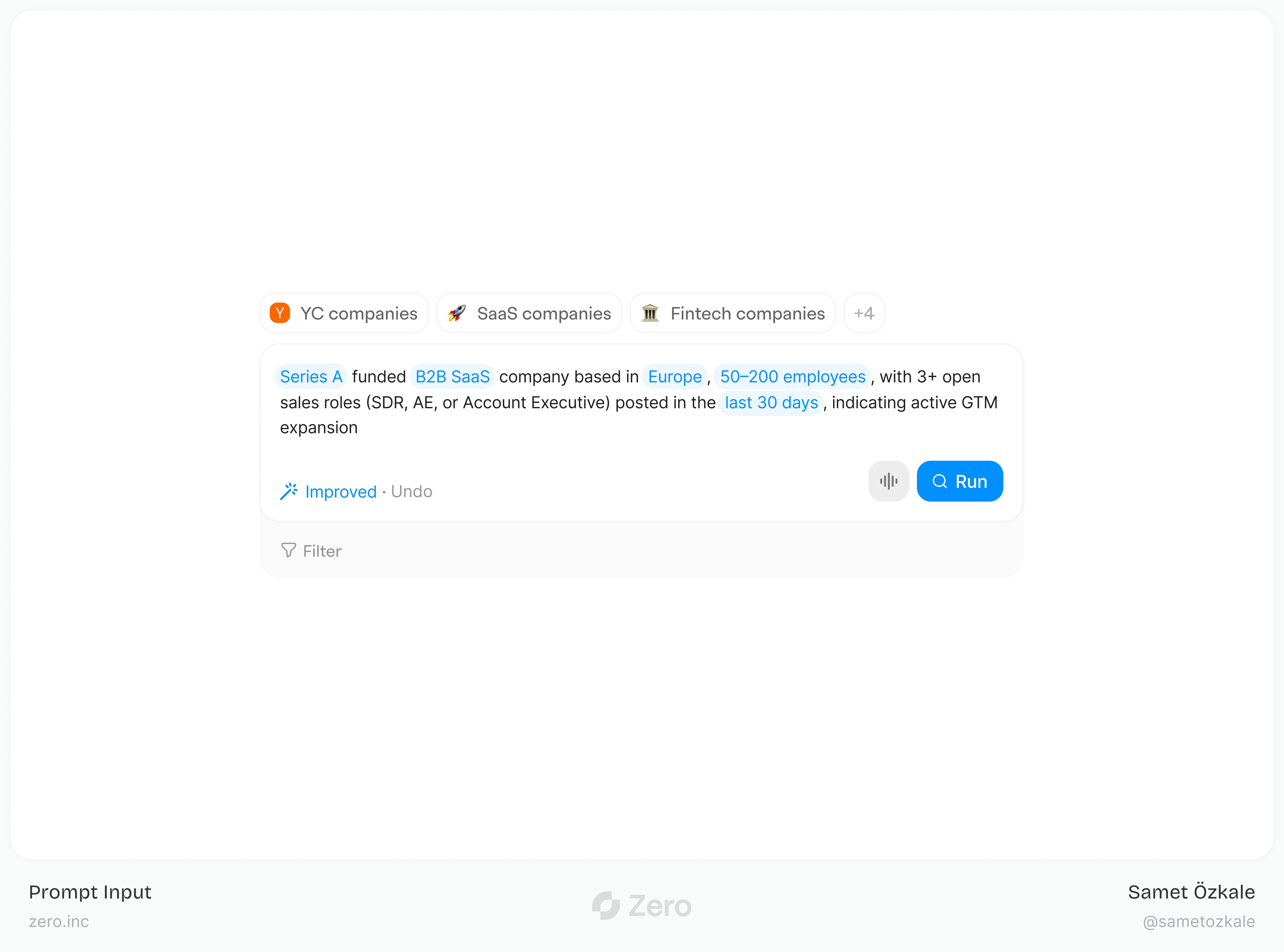
Finding accounts used to mean a wall of filters. On Zero, the first move is a brief. Chips such as YC, SaaS, and fintech set the frame. The sentence underneath carries the real ask: Series A, B2B SaaS, based in Europe, 50–200 employees, with open sales roles in the last 30 days.
Improved and Undo keep that edit reversible. Voice is there when typing is the slow part. Run starts the search. Filter stays available when someone wants the precise controls. The composer is how a revenue team says who they are looking for, without rebuilding a form every time the market shifts.
Keeping the brief in language, and the precise controls one step away, was a taste decision. The front door stays quiet. The quality shows up when someone does reach for the range, the date, or undo.
Find, win, and grow
Zero ranks accounts by fit and buying signals, then reaches them with email and LinkedIn sequences or the built-in dialer. A deal picks up where the conversation left off: what was discussed, who was in the room, and what has to happen next.
After the sale, product usage, billing, and conversations sit on the same customer record. The team can see an account going quiet, or one that is ready for more, before the renewal call. Calls, email, WhatsApp, Slack, meetings, and LinkedIn land in one timeline. HubSpot stays in sync when that is still the system of record next door.
Agents with the company’s context
Zero’s agents research leads, keep deals current, and watch buying signals. They already know who the company sells to and how it sells. A single instruction, such as reading a call transcript and opening a deal when the conversation was a sales call, can search and create companies, contacts, and deals, then log the activity.
The same API and MCP server run those agents and anything a team builds on top: widgets, dashboards, automations. Slack can answer from the CRM, so a forecast question does not require another tab and another export.
My role
I treated Zero as a design engineering problem. The interaction was decided in the product, then built and revised until it felt inevitable. Design and implementation were the same pass.
What that practice meant here:
Taste. A revenue team describes who they want. They do not assemble a filter wall to get started.
Quality. Reversible edits, a range that reads at a glance, a date control that stays out of the way, and approval that says exactly what will happen.
One piece. The composer, the path from a brief to a set of accounts, and the next step on the record, outreach, a call, a deal, a customer, shipped together.